Bentley Mulsanne Buyer's Guide
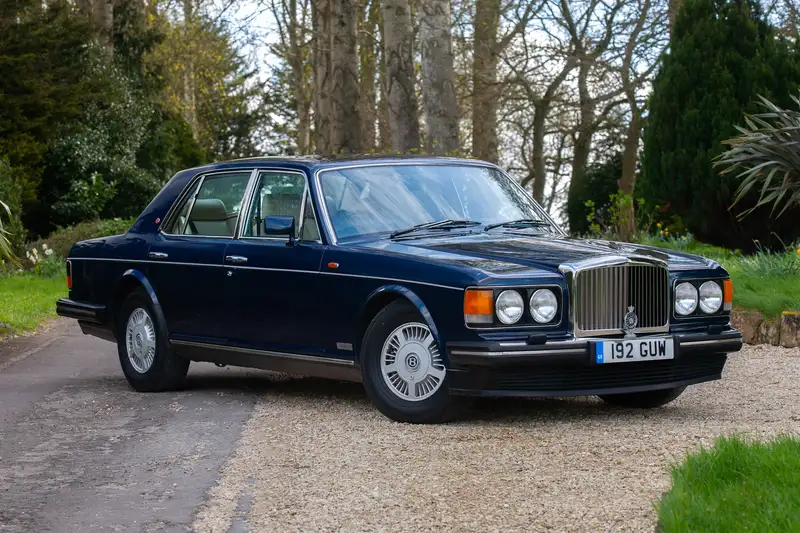
Mulsanne is another Bentley name used twice. The 1980–1992 car is the Crewe-era saloon (a Rolls-Royce Silver Spirit in a sporting tie) that spawned the Mulsanne Turbo and, eventually, the Turbo R; the 2010–2020 car is the hand-built flagship of modern Bentley, the last home of the 6.75-litre pushrod V8. Our two results measure the gap exactly: £2,700 for a 1990 Mulsanne S, £61,875 for a 2013 Mulsanne.
Know your generations
First generation (1980–1992): naturally aspirated 6.75 V8, around 300bhp in later S form, hydraulic self-levelling, and the full walnut-and-Wilton treatment. The Mulsanne S (1987–1992, like our sold car) added the Turbo R's alloy wheels and console and is the most usable of the early cars. The long-wheelbase Mulsanne L served the chauffeur trade. Second generation (2010–2020): an entirely new 505bhp twin-turbo flagship, with the 530bhp Mulsanne Speed from 2014 and an Extended Wheelbase from 2016. When it died in 2020, the 61-year-old L-series V8 died with it, a fact already working on collector sentiment.
What to pay
Two results, one per generation, so no tiers: £2,700 bought a 1990 Mulsanne S in August 2026, and £61,875 bought a 2013 Mulsanne in March 2026. Active listings support the modern car's range: a 2011 estimated at £38,000 to £42,000 and a 2012 at £20,000 to £30,000, which suggests early second-generation cars now span the twenties to low forties by estimate, with our £61,875 result at the strong end. The first-generation car at £2,700 is close to the cheapest Bentley motoring in our records.
What goes wrong
First-generation cars are a hydraulics story: brake accumulator spheres, pumps and hoses are safety-critical and life-limited, self-levelling struts leak, and head gaskets and coolant systems age. Rust takes sills, arches and screen surrounds. None of it is mysterious and all of it is documented by fifty years of specialist knowledge; the danger is simply that every job costs more than a £2,700 car is worth, which is how cheap ones become parts donors. The 2010–2020 car is robust mechanically (the V8's bottom end is essentially unburstable) but complex everywhere else: air suspension components, myriad control modules, and cambelt-free but service-hungry ancillaries. Tyres are bespoke and dear, brakes are vast, and only Bentley-literate specialists should touch the diagnostics. On both generations, interior restoration costs dwarf mechanical work; buy the best cabin available.
Our view
The modern Mulsanne is the obvious long-term hold: the final iteration of an engine line dating to 1959, hand-built in small numbers, and already trading (per our data) from the twenties by estimate to £61,875 at hammer for good examples. It will be collected. The early Mulsanne S at £2,700 is a different, riskier pleasure: magnificent to sit in and ruinous to neglect, cheap precisely because most have been. If you buy one, buy the one with the folder of hydraulic invoices and treat it as the bargain it then genuinely is.