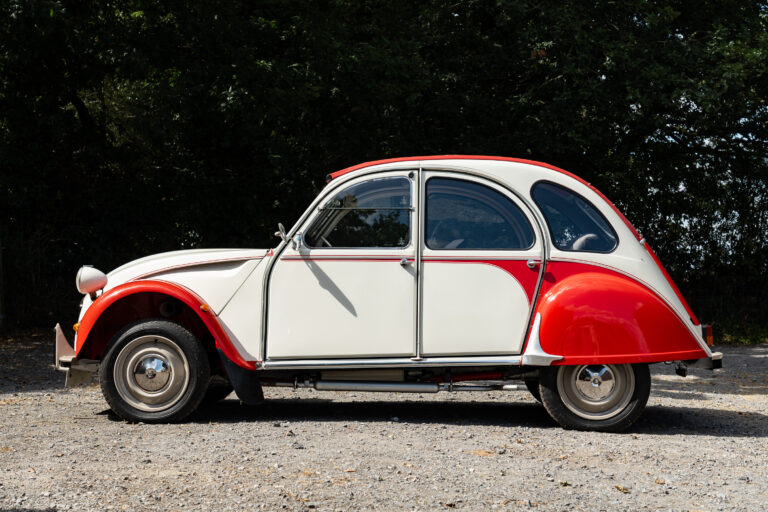
Citroën 2CV Buyer's Guide
The 2CV is the most repairable car ever sold in Britain, and our data captures its market's defining spread in just three cars: a 1985 2CV6 Charleston sold at £3,600, while a 1989 2CV6 Dolly is currently estimated at £12,000–14,000. Mechanically those two cars are nearly identical; the difference is entirely bodyshell and chassis condition, which is the whole game with a 2CV.
Know your versions
One continuous design from 1948 to 1990, evolved rather than replaced. Early ripple-bonnet cars with the 375cc and 425cc engines are rare collector pieces; the overwhelming majority of UK cars are late 2CV6 models with the 602cc 29bhp flat twin, built into the 1980s (the last cars came from the Portuguese factory). Within those, the Charleston (1980–1990, two-tone paint, the best-selling special) and the Dolly (another two-tone special) dominate auction entries, exactly as our data shows. The Fourgonnette van (1951–1978) has its own following, and the twin-engined 2CV Sahara (1960–1966) is a genuine rarity that trades in a different universe from anything quoted here.
What to pay
One sold result: £3,600 for a 1985 2CV6 Charleston in April 2026, which represents a usable driver-grade car. The live market shows the ceiling for ordinary specials: £12,000–14,000 estimated for a 1989 Dolly, which is restored-car money. A 1986 2CV Special is also live without an estimate. With a single hammer price we will not draw a curve; the honest reading is that scruffy-but-sound cars sit around our £3,600 result and properly restored late cars ask three to four times that.
What goes wrong
The chassis is the purchase decision. Original platform chassis rot from the inside; most surviving cars have had a replacement (galvanised replacements are the desirable fix), and an original chassis on a cheap car should be assumed rotten until proven otherwise. The bodyshell rusts everywhere it can: floors, bulkhead, door bottoms, the boot floor and around the rear seatbelt mounts; every panel is available new, which is why restoration is a solved problem rather than a gamble. The 602cc twin is nearly indestructible if the oil is changed; points, carburettor balance and exhausts are the running items, and kingpins wear and are the classic MOT failure, a known and affordable job. Interconnected suspension cylinders and knife-edge pivots want greasing. None of this is expensive; all of it is labour.
Our view
Buy the chassis and shell, ignore the rest: everything mechanical on a 2CV can be renewed for less than a respray. At our £3,600 sold result the Charleston was strong value against a £12,000–14,000 restored Dolly estimate, and that arithmetic usually favours buying the best body you can afford rather than restoring a cheap one. As a car to keep running indefinitely the 2CV has almost no equal: total parts availability, a huge club scene, and mechanicals a first-time owner can maintain with hand tools. It will outlast most things on this site.