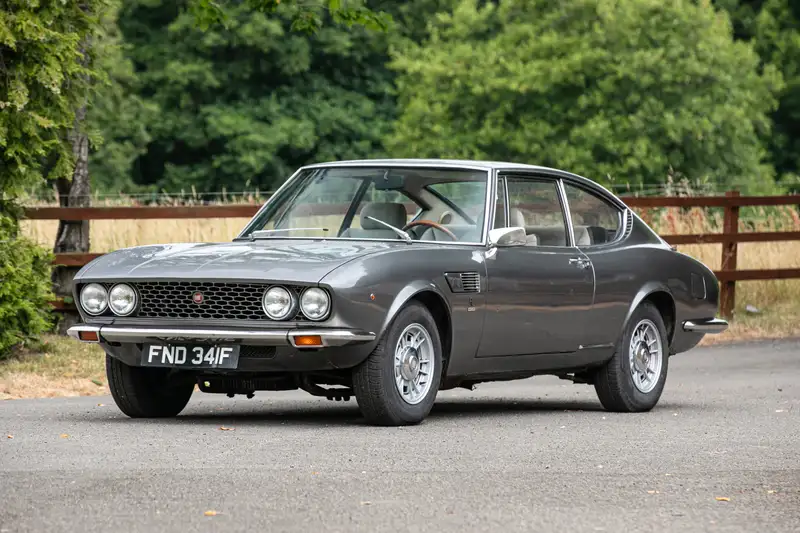
Fiat Dino Buyer's Guide
The Fiat Dino exists because Ferrari needed to homologate its V6 for Formula 2 and Fiat had the production capacity. The result is a Ferrari engine in a beautifully styled Fiat, and our two sold results define the market's structure precisely: a 1968 Dino Spider 2000 at £51,750 and a 1968 2.0-litre Coupé at £20,813. Same year, same engine, two and a half times the money for the open Pininfarina body.
Know your versions
Two engines, two bodies, 1966–1973. The 2.0-litre cars (1966–1969) use the all-alloy 160bhp quad-cam V6 in a Pininfarina-designed Spider or the longer Bertone-styled Coupé, on a live-axle chassis. The 2.4-litre cars (1969–1973) enlarged the V6 to 180bhp with an iron block, and, more importantly, gained independent rear suspension and a ZF gearbox; assembly moved to Maranello alongside the Ferrari Dino 246, which shares the engine. The 2.4 is the better car to drive; the 2.0 Spider is the rarer and prettier thing; the Coupé, built in far greater numbers than the Spider, is the value entry throughout. Spider production was a fraction of Coupé production, which the gap between our two results reflects faithfully.
What to pay
Two sales: £51,750 for the 1968 Spider 2000 (March 2026) and £20,813 for the 1968 2.0 Coupé (August 2026). That is the whole of our data, and it maps the market's known shape: Coupés at roughly £20,813 in usable order, Spiders at £51,750 and climbing with condition. We hold no results for 2.4 cars of either body; nationally they command a premium over the equivalent 2.0, with the 2.4 Spider the most valuable of all four combinations. No active listings at present.
What goes wrong
The engine is the joy and the bill. The quad-cam V6 is a genuine Ferrari unit: sodium-filled exhaust valves on the 2.0, chain tensioners, and carburettor synchronisation across triple Webers all want a specialist who knows the type, and a top-end rebuild costs Ferrari money regardless of the badge on the nose. Evidence of regular use and expert servicing is worth more than low mileage. The body is the second front: these rust with Italian-sixties enthusiasm in the sills, floors, arches, valances and around the screen surrounds, and Spider structural rot is costlier still because the open shell depends on its sills. Panel supply is thin; repairs are fabrication, not catalogue shopping. Magnesium-alloy wheels corrode. Interiors and glass are scarce, so completeness matters when buying a project. The 2.4's independent rear end and ZF box are durable; 2.0 live-axle cars are simpler again.
Our view
The Coupé at our £20,813 result is one of the cheapest ways into a genuine Ferrari engine ever offered, and it is a proper four-seat GT rather than a compromise; as a keeper it wants an owner committed to the engine's care, but nothing about it is unsustainable with the Dino specialist network that supports the 246. The Spider has already been found; £51,750 for a 2000 is the market pricing Pininfarina bodywork and rarity correctly. Buy on shell and engine history, in that order, and let the badge snobs keep overpaying for the Ferrari-badged version of the same motor.