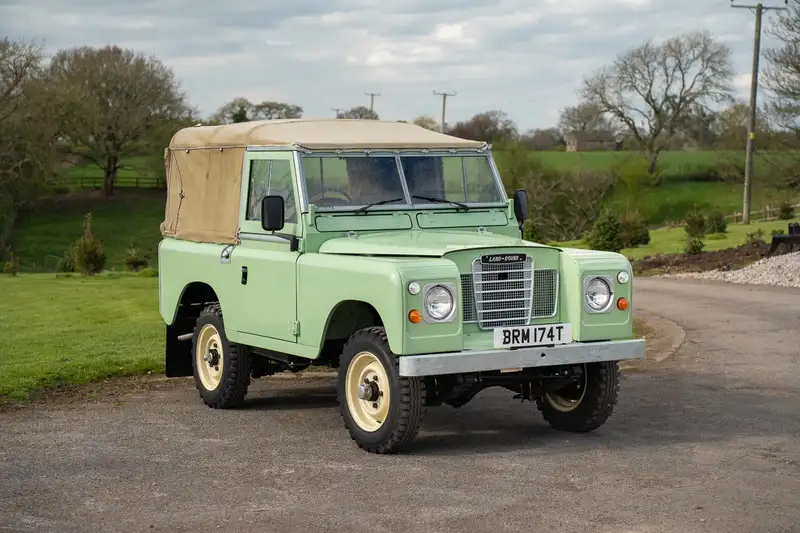
Land Rover Series III Buyer's Guide
The Series III (1971–1985) is the last and most usable of the leaf-sprung Land Rovers, and our two sold results neatly bracket the market: £2,507 for a 1972 car sold with no reserve, £18,000 for a 1979 88-inch with canvas tilt. Between those figures sits nothing but condition, originality and how much chassis welding the last owner actually paid for.
Know your versions
One generation, but several bodies and two wheelbases. The 88-inch is the classic shape and the one collectors want; the 109 offers more space and less charm. Most cars carry the 2.25-litre petrol four (77hp in our catalogue), with the 2.25 diesel a slower, noisier alternative; six-cylinder and V8 Stage One 109s exist but are rarer. The Series III brought an all-synchromesh gearbox, the plastic grille and a revised dash, which makes it the easiest Series car to live with. The military Lightweight (1968–1984) is its own sub-market: an active lot in our data is estimated at £12,000 to £16,000, comfortably above equivalent civilian estimates.
What to pay
Only two sales, so read them individually: £2,507 bought a 1972 car at no reserve in March 2026, which is project or rolling-restoration money; £18,000 bought a tidy 1979 88-inch canvas tilt in May 2026, which is what a genuinely sorted example now costs. Active estimates fill in the middle: usable 88s at £3,500 to £4,500 and £5,000 to £6,000, better cars at £8,000 to £9,000 and £10,000 to £12,000, a restored Station Wagon with television provenance at £10,000 to £15,000, and the Lightweight at £12,000 to £16,000. The gap between our two results is the restoration bill, so it is usually cheaper to buy the £18,000-grade car than to make one.
What goes wrong
The chassis is the purchase decision: rear crossmember, outriggers and dumb irons rot from the inside, and fresh underseal is more often concealment than care. A galvanised replacement chassis exists and transforms a car, but check any "new chassis" claim against paperwork. The bulkhead rots at the footwells and door pillars and is harder to source well than the chassis. Mechanically the 2.25 petrol is close to indestructible if the oil is changed; the gearbox wears its layshaft and jumps out of second, the steering relay seizes, and swivel housings pit and weep. Leaf springs sag and bushes die, which is why so many drive worse than they should. Parts supply, from complete chassis down to trim clips, is about the best in the classic world.
Our view
A sorted 88-inch petrol at our £18,000 result level is one of the safest classic purchases there is: total parts availability, a huge club scene, and a vehicle simple enough to maintain on a driveway. The £2,507 end only makes sense if you cost the welding honestly. Of the variants in our data, the Lightweight is the collector's pick, but a good civilian 88 is the one to actually use.